Friday, 14 June 2024

Inside Cinema - Shorts - 31 to 40


The next ten of Inside Cinema - Shorts on this Blog starts with Episode 31 Dancing Teens. James King introduces with "Welcome to the 1980's. It's all song and dance, films trying to replicate the success of Saturday Night Fever (1977) and Grease (1978). Some are basically musicals: Fame (1980), Flashdance (1983), Footloose (1984), and Dirty Dancing (1987). But we also see clips of song and dance in films such as Risky Business (1983), Pretty in Pink (1986), Desperately Seeking Susan and The Breakfast Club (1985). Who knew there were so many from that decade. And why is Wayne's World  (1992) included? 

Above, of course, are Nick Frost and Simon Pegg from Shaun of the Dead (2004), in Episode 32 Movie Buddies narrated by Jamie Maisner. I thought this would be good, and it was. Again. predictably came Wayne's World (1992) and then a few more at lightning speed. But it slowed for a great clip with Sam carrying Frodo in Lord of the Rings: The Return of the King (2003). I didn't know Swiss Army Man (2016) with Paul Dano and Daniel Radcliffe, but then came more including Hot Fuzz (2007), yes them again, Butch Cassidy and The Sundance Kid (1969), obviously, and the wonderful Withnail and I (1987).

Episode 33 is Fast and Furious Families with Steph Watts. Nineteen years and nine films in the franchise starting with The Fast and the Furious (2001). Enough said.

But Episode 34 Licence to Spoof with Ali Plumb was funny. All about ripping off James Bond. Each fragment starts with a Bond special followed by it's imitation. That opening of every film's credits, for example, is here in Our Man Flint (1966), Kingsman (2015) and Johnny English (2003). Gadgets include The Pink Panther (1963), Villains with Austin Powers (1997) and, of course who could forget the Olympics Opening Ceremony.

Elizabeth Sankey narrates Episode 35 Film Flirtations. Getting it together in the movies Pretty Woman (1990), Out of Sight (19980, and In the Mood for Love (2000) I liked the way this episode dawdles over each film instead of the usual rush. We see Richard Linklater's Before Sunset (2004), Ten Things I Hate About You (1999) and ends with The Philadelphia Story (1940). A superior episode.

Episode 36 is Studio Ghibli Magic with Michael Leader. I think I saw Spirited Away (2001) and Howl's Moving Castle (2004) but not My Neighbour Totoro (1998), I didn't know the stage adaptation came from the film, or Kiki's Delivery Service (1989). All the many others I had not even heard of. But the studio is thirty five years old and still going strong.

And who are these two from Episode 37 Bands in Films with Elizabeth Sankey? But we start with, yet again, Wayne's World (1992), then Almost Famous (2000), This is Spinal Tap (1984), didn't like it the first time but must watch again, my post of the 18th March 2021 said I wish I hadn't bothered watching it, then back to the start of these movies with The Blues Brothers (1980). But what is Josie and The Pussycats (2001). The clip from The Commitments (1991 included the audition montage. This device should get it's own episode. Not sure about just the folk singer in Inside Llewyn Davis (2013) but the episode ends with that great line from Almost Famous on the bus when he says "I have to go home" and Kate Hudson replies "You are home".

Lust, Camera, Action is Episode 38 with Christina Newland (she was one of the team on the later series of "The Directors" on Sky Arts). Starting with the Magic Mike franchise and a rush through many more. But here is Rudolf Valentino in the 1920's when, we were told, more women went to the cinema than men. Onwards to the 1950's to land with Robert Redford in The Way We Were (1973). Then those films starring Richard Gere.


Episode 39 The Dolly Boom was brilliant. How the directors used a zoom lense to keep a fixed focus while moving (or dollying) the camera in or out. Still not exactly sure how that works, but cue Alfred Hitchcock's Vertigo (1958) which apparently was the first to use this technique. When James Stewart climbs that building towards the end, the bottom just seems to fall away. We see clips from Road to Perdition (2002), Sugarland Express, (1974), and Marnie (1964) where Hitchcock used it again. But it was Jaws (1975) that had that iconic shot on the beach. 

Other films we see include La Haine and The Quick and the Dead (both 1995), Sam Raini used it nearly all the time. It then became somewhat a parody in films such as The Mask (1994). Far better is the shot in the diner in Martin Scorsese's Goodfellas (1990). What is going on behind the window seems more interesting than the conversation inside. 

The last in this set is No 40 Pop Docs with Simran Hans. We see lots of archive footage from a number of documentaries following pop stars in concert and behind the scenes. With Katy Perry: Part of Me (2012), Miss Americana (20200 with Taylor Swift, Gaga: Five Foot Two (2017). That was it, except it kept going back to MIA (2018). Who is that? So all female and not a sign of the big bands. Maybe next time?


Wednesday, 12 June 2024

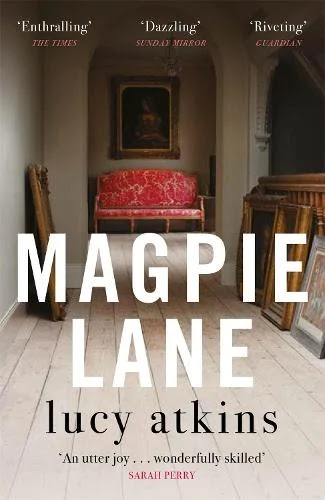
The Bachelors, Magpie Lane and Behind the Scenes at the Museum


Patrick Seton is the most awful character since Tom Ripley. Everything he says is a manipulative lie. Especially to poor pregnant Alice. But here are other bachelors, Ronald Bridges and Mathew Finch who have tumbled his little game as a fake medium and possibly not even married when he tells Alice he is getting a divorce. A large cast of other characters including more bachelors. I cannot remember if anyone is actually married? Including Marlene Cooper whose husband "had been buried three months when, convinced of his dynamic survival (at a spiritualist meeting), she had him dug up and cremated". This is all pure Muriel Spark, humour with an edge. I have not read a book recently with so much dialogue, pages and pages. Late on, ten pages of a conversation between two strangers who actually knew of each other, is quite exceptional. Fortunately, I still have a few of this author's books still to read.


For me, the best thing about this book, and the only reason I bought it, was the location. Oxford plays a large part and almost every interesting location appears at some point. We are in standard thriller territory, novels of this type are not my normal choices. Dee is our possibly unreliable narrator, taken on as nanny to young Felicity at, yes, the new master's lodge. But we know early on that Felicity has disappeared. So backwards and forwards we go as Dee explains to the police, and more so to us, what it was like before the possible abduction.

Halfway through we meet Linklater, but his involvement is more as a tour guide, hence more about the history of Oxford. We gradually learn a lot about the background of Dee herself and why the police might be interested in her. As the tension ramps up towards the end, we try to guess what has happened to Felicity. Not the best constructed finale, but isn't that just typical.


As an experiment, I thought that I would read again a book from before I started on goodreads. So naturally I veered towards a Kate Atkinson novel. This is what I wrote on my blog on 7th August 2010.

Kate Atkinson's first novel not only won the Whitbread prize of 1995 for the best first novel, but was also their book of the year in all categories. Behind the Scenes at the Museum is actually quite exceptional and will probably be the best book I will read this year. Our heroine, Ruby, is born in 1952, and she tells the story of her family, going back to her great grandmother. The first chapter is hilarious as Ruby starts by introducing her family from when she is in the womb. There are many laugh out loud moments, but others that bring a tear to the eye. I had already read one novel by the author, a very good crime drama When Will There Be Good News, and am looking forward to her Case Histories among others.

Reading again, I was less sure about the alternating stories of Ruby and her ancestors, particularly that of her grandmother Nell. Somehow the latter seemed to disrupt the narrative of the main character. I had forgotten how her story follows her through her childhood and teenage years with only a few pages at the end about her adult life. But with Ruby born in 1952, there was much that resonated from my own childhood. For example in 1959 when Ruby is seven and I'm fourteen, there is never any heat in the bedrooms. And we both watched the coronation in 1953 on a tiny black and white TV.

When you are one of three or four children, there are very few times you have your mother to yourself. Ruby's was with her buying her school uniform. "Some of the most pleasant times we spent together". Mine was with Mum, taking the bus and then a trolley bus for what we thought was an interview for my new Grammar School. (It was only an introduction). But the best parts are those where the humour stands out. Such as when Ruby's mother goes missing and her father has to cope with four little girls.

The author's home city of York plays a large part in the novel. In the last few pages Ruby has had enough. "It seems like a fake city, a progression of flats and sets and white cardboard battlements and medieval half-timbered house kits that have been cut and glued together. The streets are full of strangers - up-market buskers , school parties and coach parties and endless varieties of foreigners." But this is only a prelude to a wonderful emotional ending.

Tuesday, 11 June 2024

Movies at Home: Saint Maud, All is True and Batman


Saint Maud is a psychological thriller more than a horror film. This is Rose Glass's first feature (see post for her latest Love Lies Bleeding) for the British writer/director. Cast as Maud is Morfydd Clark as the nurse taking care of Jennifer Ehle's ex-dancer Amanda. Maud is a really strange character who you would not want as your nurse. But Amanda, perhaps, needs some creepy conversation. Maud has only recently been converted to her religion and demonstrates all those characteristics of the newly found calling. Amanda treats her with a mixture of disdain and comfort. She is terminally ill and her diet mainly comprises of pills and alchohol. She gives Maud a book on William Blake by Morton D Paley, full of weird images. Somehow this film seems like a dance between the two main characters, except that Maud is becoming more and more weird. There are glimpses of her state that veer into horror, but it is only the ending that is gruesome. I liked the muted light of the house in Highgate, the interiors match the mood. But the few exterior scenes are filmed in Scarborough when Maud takes a break from her post. Including that one at the very end.

I was wondering why I didn't see All is True at the cinema. I found out why. Here is director Kenneth Branagh as a retired William Shakespeare, back home with his almost estranged family. Ben Elton's screenplay is OK. it's just the story about that is pretty boring and very downbeat. The fact that their son Hamnet was dead hovers in the background (although he does occasionally appear to Will), as does the fire that burnt down the Globe Theatre. William's unhappy marriage to Judy Dench's Anne Hathaway is replicated by daughter Susanna's. Lydia Wilson is superb. So at home, not all is sweetness and light. There are so many scenes in the dark with those muted candlelit interiors. Then who arrives but the Earl of Southampton played gloriously by Ian McKellen. But his scene with William could have taken not much more than a day to film. Again in the dark. All too predictable.


My post of the 7th February this year on Inside Cinema included this note about Tim Burton's Batman:

Much more interesting was Burton's Gotham. (There are) clips from the 1989 film Batman. The exterior crowd scenes look great, but it was the production design of director Tim Burton and Oscar winner Anton Furst (Full Metal Jacket) that was truly remarkable. Hugely expensive, these sets at Pinewood Studios would "unlikely ever to be repeated, matched or surpassed." The film is compared to Christopher Nolan's Batman trilogy that went for real locations, not that futuristic nightmare. 

I realised I had the DVD and watching it this week, I concentrated on all that expensive production design. The film starts at night and the whole architecture of Gotham City is there. Quite amazing. The interiors are equally good, it's just that a TV does not do them justice. If ever one movie needed a new cinema release, it's this one. Except ..... the story and screenplay struggle to match the background. I felt that Michael Keaton was a lightweight in the title role compared to Nicholson's Joker. Give me Nolan's trilogy anytime. 

Saturday, 8 June 2024

Penstemon: Arctic Fox and Electric Blue


27th May 2024

Penstemons are one of my favourite plants, although they are sensitive to the cold and do not last more than a couple of years. This month I added a new one to the main border. The Penstemon Arctic Fox is the white flower in the picture at the top. Complimented by the blue Geranium and the pink Astrantia at the back. Not very visible in the photo below, just that hint of white this side of the far Alliums.

In my post of 10th June last year I noted that all the Penstemon Firebird had perished in the succession of heavy frosts. However the new Penstemon Electric Blue below survived and this year is looking better than ever. With more flowers to come.

Update Today

The new white Penstemon had disappeared in the main birder, being overwhelmed by all the other plants. So yesterday it was transplanted opposite the blue one and looks a lot happier. Hopefully it will survive the move.

Friday, 7 June 2024

Love Nina. Despatches from Family Life


I can understand why this book had mixed reviews. I read just a few pages at a time as a rest from my novel, but on it's own it may have been a trial. Nina Stibbe is twenty and has left her home in Leicester to work as a live in nanny. Her employer is Mary-Kay Wilmers (deputy editor of the London Review of Books) who lives with her two sons in a big house in Gloucester Crescent in a particularly nice part of Camden. Alan Bennett lives next door! He actually appears many times as he often has dinner with the family.

The book is made up purely of Nina's letters to her friend Victoria back in Leicester. So an educated household. The boys are Sam and Will Frears (yes, sons of the film directer Stephen Frears) and a neighbourhood of arty types. Just reading the list of characters at the beginning made me gasp. Nina tells us "they are always laughing" and "people come round loads". All huge material for these letters and great fun for us. So much are actual conversations that Nina quotes verbatim. I have never laughed so much:

Talking with Alan Bennett at dinner about Jim'll Fix it and asking what he would choose to do. He would think about it. Sam says he could have tea with chimpanzees. He answers "I already do". This is all in Part 1 from 1982 to 1984, after which in Part 2, Nina moves out to study at Thames Polytechnic and lives in Mary Hope's house in Regent's Park Terrace. But she still seems to visit Gloucester Crescent, almost as if she still lives there even though another nanny is in residence. I found this later section far less amusing and interesting than the first. The stuff she writes about college is just not the same. And the only reason why I did not give it five stars.

The Garden in early June


The main border is not quite in full flower, but the blue Geranium and the pink Astrantia are particularly good at the moment.

The Dahlia Figaro Mixed that I planted have been a disaster having all but six of the thirty eaten by snails. I think everyone has had this problem this year. So in the bedding border below, I found twenty four Verbena at Chiltern View garden centre that were, in fact, cheaper than buying the dahlias online. 


Next door is the Penstemon Electric Blue.


As usual, the Campanula does well next to the conservatory wall.


The poppy in the hot bed has never looked this good.


I'm still not sure if the brand new plant below is a Hydrangea. But it has flowered well.


As has the rose Blue for You..


More roses in bloom.


These are the  Dianthus in pots in the side border with the roses behind.


The Philadelphus is at the opposite end of the side patio.


And finally, this is the other Philadelphus at the front of the main border.


The Far Lawn


The photo above do not really show how bad was the moss this year in the lawn at the far end of the garden. There was more moss than grass. All due to it being completely in the shade from October on. My post of the 29th January suggested that applying Pro Kleen's Iron Sulphate that month might do the job of killing the moss. Then with their Grass Green treatment in April, the lawn might improve. And here it is today. The best it has looked for very long time.