This is why I go to a book club. I would never have chosen to read a story by Tan Twan Eng that focuses on Malaya, especially as it covers the second world war, the post war Emergency, and almost modern day. It turned out to be an extraordinary piece of writing. The Garden of Evening Mists has been created in the foothills of the mountains by Nakamura Aritomo. He was once the Gardner to the Emperor of Japan. The story is narrated by Teoh Jun Ling. She was only seventeen at the outbreak of war, and ten years later is on a mission that leads to Aritomo. The novel jumps backwards and forwards from almost modern day to those other times. Not only did it tell me so much about the trauma suffered in the far east during the war and after, but it weaves a magical tale of two very interesting characters. Unforgettable.
Maggie O'Farrell is one of my favourite authors. Whilst not quite reaching the heights of some of her other novels, her latest Instructions for a Heatwave is still a little gem. This is a story about a family and it's secrets. When Gretta's husband disappears, their three grown up children come together to help. But old wounds surface, not helped by the children's own relationship problems. O'Farrell has such a wonderful turn of phrase, it is a delight to read the warmth and the light touch of her writing. As someone says, words are not just the written kind. The dialogue is very special. The story is absorbing and gains powerful momentum in the final third. All with a gripping and emotional ending. Superb.
Wednesday, 13 November 2013

Tuesday, 12 November 2013
A Career in Construction - Part 4
During the five year training scheme, we would take the examinations of The Institute of Quantity Surveyors. These replicated the exams run by The Royal Institution of Chartered Surveyors, the body we were not allowed to join as we worked for a building contractor. Only those in professional practice and local authorities could join the RICS. The IQS did have some professional members who preferred a specialised organisation for Quantity Surveyors rather than being amongst a load of estate agents and other disciplines. So did we.
The IQS prided themselves on the quality of their exams, always trying to be superior to those of the much bigger RICS. There was the identical structure of Parts 1, 2 and 3. Each Part had six or seven different subjects, so exams were spread over three or four days. We took Part 1 after the first two years at college, Part 2 a year later and Part 3 at the end of the five years. Each time the pass rate seemed to be stuck about 30%. I was lucky to pass all the exams first time, except for one referral in Part 2 that I took on it's own the following year.
I remember so well the day we got the results of the final exam. I had left the flat in Kingston before the post arrived. Happy to wait until the evening, someone phoned up for the results. I could not believe I had passed and had to drive home at lunchtime to pick up the envelope that confirmed I was through, and became an Associate of The Institute of Quantity Surveyors.
Ours was a great organisation. There were lots of events and a quarterly journal full of interesting stuff. So when the RICS made overtures to absorb our Institute, we successfully voted against this proposal. However, their persistence resulted in another vote, and in 1983, by a tiny majority, we became part of the RICS. I became an Associate before becoming a Fellow in 1989. Apart from the kudos of being FRICS, the loss of our old institute was a disaster. The contracting side of Quantity Surveying is basically ignored, and very few newcomers to our industry now join. Very sad.
Great West End Theatres
The first documentary series of Great West End Theatres on Sky Arts 2 was a fascinating story of the origins, architecture and history of the first ten theatres in a production that eventually visits all forty. These were:
Theatre Royal Haymarket
Prince of Wales Theatre
Piccadilly Theatre
Wyndham's Theatre
St Martins Theatre
Ambassadors Theatre
Her Majesty's Theatre
Palace Theatre
Noël Coward Theatre
Theatre Royal Drury Lane
Some of these were familiar to me and some were not. The series is entertainingly presented by Donald Sinden and directed by his son Mark. What stood out for me was the vast amount of money that has been recently invested into these theatres by the likes of Cameron Macintosh and Andrew Lloyd Webber. I guess they now look better than when they first opened.
I was Heartbreak House at The Theatre Royal Haymarket in 1992, Les Miserables at the Palace Theatre in 1991and Phantom of the Opera at Her Majesty's Theatre in 1993. The Noel Coward Theatre used to be called The Alberry Theatre where we saw Hay Fever in 1992 and Oliver sometime around 1979.
The Mousetrap has been performed continuously at St Martin's Theatre since 1974 having transferred from the next door Ambassador's where it had run for 22 years before that. We went to see it in 1987. The Prince of Wales Theatre was most impressive. The art deco restoration in 2004 under Cameron Macintosh is quite something. Note - there are tours of the theatre on Friday afternoons. Mama Mia was performed there for eight years following it's transfer from the Prince Edward Theatre.
Theatre Royal Haymarket
Prince of Wales Theatre
Piccadilly Theatre
Wyndham's Theatre
St Martins Theatre
Ambassadors Theatre
Her Majesty's Theatre
Palace Theatre
Noël Coward Theatre
Theatre Royal Drury Lane
Some of these were familiar to me and some were not. The series is entertainingly presented by Donald Sinden and directed by his son Mark. What stood out for me was the vast amount of money that has been recently invested into these theatres by the likes of Cameron Macintosh and Andrew Lloyd Webber. I guess they now look better than when they first opened.
I was Heartbreak House at The Theatre Royal Haymarket in 1992, Les Miserables at the Palace Theatre in 1991and Phantom of the Opera at Her Majesty's Theatre in 1993. The Noel Coward Theatre used to be called The Alberry Theatre where we saw Hay Fever in 1992 and Oliver sometime around 1979.
The Mousetrap has been performed continuously at St Martin's Theatre since 1974 having transferred from the next door Ambassador's where it had run for 22 years before that. We went to see it in 1987. The Prince of Wales Theatre was most impressive. The art deco restoration in 2004 under Cameron Macintosh is quite something. Note - there are tours of the theatre on Friday afternoons. Mama Mia was performed there for eight years following it's transfer from the Prince Edward Theatre.
Sunshine on Leith, Captain Phillips and Philomena
At a fraction of the budget, Sunshine on Leith showed what the film versions of Mama Mia and Les Miserables were missing. And that was total energy and commitment from the cast and crew. Dexter Fletchers' adaptation of the Dundee Rep stage show is a remarkable feat. It does help that the Edinburgh setting looks so great, and makes for a tourist promotion for it's pubs. ( I still remember the one across the road from our hotel on our visit there). Of course the songs of The Proclaimers are terrific and they are sung which such gusto and warmth. Jane Horrocks and Peter Mullan are superb and the younger members of the cast are also very good. This is a wonderful feelgood movie quite unlike anything I have seen for ages. Think Gregory's Girl with great songs. The finale based on I 'm Gonna Be (500 Miles) is worth the price of admission alone.
So much has been said about Captain Phillips that there is little I can add. Paul Greengrass takes his hand held camera on board Tom Hanks' hijacked container ship. The tension is palpable from the start and never lets up. Outstanding movie making.
I was slightly disappointed with Philomena. Although it is a moving story, and the acting of Judi Dench and Steve Coogan is first class, I found it a little predictable and unconvincing. I think this may have had something to do with the script. Philomena is a wonderful character, but just a little too much seeking our sympathy. She did have a proper family after all. And Martin Sixsmith is portrayed as unbelievably too hard and sarcastic, I guess as not to glamorise the writer of the book on which the story is based. But there is much to enjoy in the relationship of this mismatched couple, and director Stephen Frears creates a wonderful atmosphere. I have to say that the last half hour is fantastic, so my overall reservations are actually too trivial.
So much has been said about Captain Phillips that there is little I can add. Paul Greengrass takes his hand held camera on board Tom Hanks' hijacked container ship. The tension is palpable from the start and never lets up. Outstanding movie making.
I was slightly disappointed with Philomena. Although it is a moving story, and the acting of Judi Dench and Steve Coogan is first class, I found it a little predictable and unconvincing. I think this may have had something to do with the script. Philomena is a wonderful character, but just a little too much seeking our sympathy. She did have a proper family after all. And Martin Sixsmith is portrayed as unbelievably too hard and sarcastic, I guess as not to glamorise the writer of the book on which the story is based. But there is much to enjoy in the relationship of this mismatched couple, and director Stephen Frears creates a wonderful atmosphere. I have to say that the last half hour is fantastic, so my overall reservations are actually too trivial.
Friday, 8 November 2013
A Career in Construction - Part 3
The George Wimpey training scheme for Quantity Surveyors before I joined was based entirely on day release to attend college once a week with additional evening classes. My year was the first to try an entirely different method. This was called a Block Release Course and required 15 weeks per year at college for the first three years and ten weeks per year for the last two. These were broken down into five week sessions at Brighton College of Advanced Technology, each five weeks during one college term. The course was designed around the examinations of The Institute of Quantity Surveyors.

Our first digs in Brighton were in Silverdale Road, that is actually in Hove. There must have been six of us in the house, those were happy, carefree days. We always had time for last orders at the nearby pub. See postings February 2010.
The first January we were in Brighton coincided with the Central Estimating Dinner and Dance. This was a huge event paid for by the company and our presence was required. We did have to hire dinner suits for the occasion, and I found mine in Brighton. Some of the others had hired theirs in London so these had to be brought down by the training manager, Mike Godber. Having left them at our digs, some wag decided to mix then up which caused a big ruckus and much laughter.
When we arrived at the venue (possibly the massive room above Derry and Toms on Kensington High Street), we were struck by the organisation. A large dance band played on the stage, playing quicksteps, waltzes etc. So we just watched, enjoyed the food and free bar! But half way through the most amazing thing happened. Now you have to remember this is January 1964, and the vast majority were mature people. But low and behold, a rock group took to the stage. How someone had persuaded the organisers to let one in, I shall never know. But there we were, just the trainees bopping alone on the dance floor to the music of The Beatles, Cliff, Gerry and the Pacemakers and The Searchers. I guess the more adventuress of the older staff might have joined in. Absolutely amazing.
Our first year ended in the September and we were distributed through other departments of the company. The lucky many were transferred to the regions for the year, unfortunately I got stuck in a private housing unit in Flyover House in Chiswick where I basically wasted a year and learnt nothing. The most memorable feature being the canteen. But by the September of 1965 I had moved out of Riverview Gardens, sampled the boring single life in a bedsit, and moved in with my friend Bob Owen to the attic flat of 7 Airedale Road in Chiswick, the home of Mr and Mrs Gosden, and our home for the following momentous year of 1966, and my third successive year in London.

However, much as we enjoyed the benefits of paid work experience and college life, this system was pretty disruptive for people we worked for, disappearing for weeks at a time. I believe this experiment only lasted a couple of years.
Our first digs in Brighton were in Silverdale Road, that is actually in Hove. There must have been six of us in the house, those were happy, carefree days. We always had time for last orders at the nearby pub. See postings February 2010.
The first January we were in Brighton coincided with the Central Estimating Dinner and Dance. This was a huge event paid for by the company and our presence was required. We did have to hire dinner suits for the occasion, and I found mine in Brighton. Some of the others had hired theirs in London so these had to be brought down by the training manager, Mike Godber. Having left them at our digs, some wag decided to mix then up which caused a big ruckus and much laughter.
When we arrived at the venue (possibly the massive room above Derry and Toms on Kensington High Street), we were struck by the organisation. A large dance band played on the stage, playing quicksteps, waltzes etc. So we just watched, enjoyed the food and free bar! But half way through the most amazing thing happened. Now you have to remember this is January 1964, and the vast majority were mature people. But low and behold, a rock group took to the stage. How someone had persuaded the organisers to let one in, I shall never know. But there we were, just the trainees bopping alone on the dance floor to the music of The Beatles, Cliff, Gerry and the Pacemakers and The Searchers. I guess the more adventuress of the older staff might have joined in. Absolutely amazing.
Our first year ended in the September and we were distributed through other departments of the company. The lucky many were transferred to the regions for the year, unfortunately I got stuck in a private housing unit in Flyover House in Chiswick where I basically wasted a year and learnt nothing. The most memorable feature being the canteen. But by the September of 1965 I had moved out of Riverview Gardens, sampled the boring single life in a bedsit, and moved in with my friend Bob Owen to the attic flat of 7 Airedale Road in Chiswick, the home of Mr and Mrs Gosden, and our home for the following momentous year of 1966, and my third successive year in London.
Thursday, 7 November 2013
The Garden in November
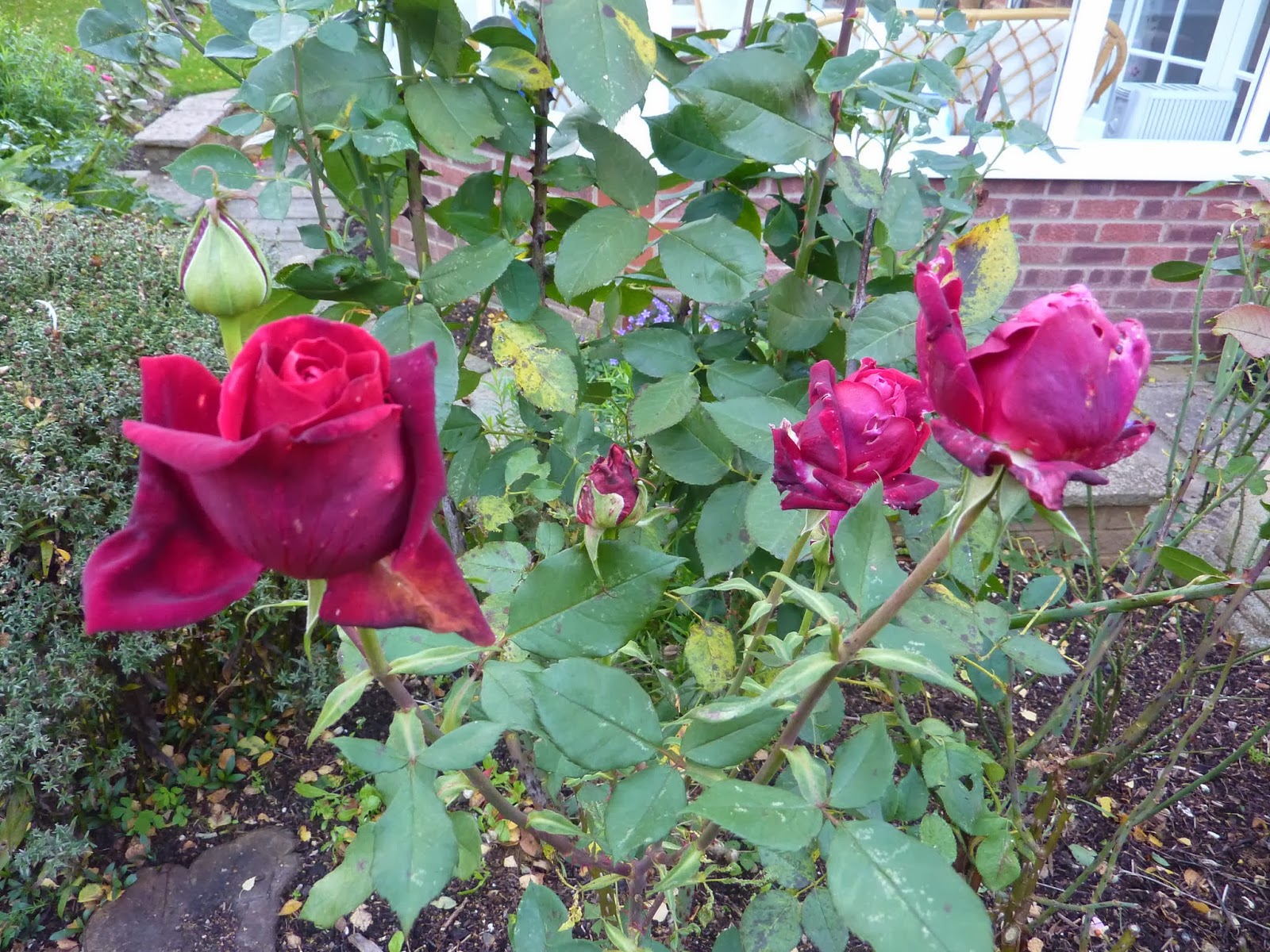


At least the silver birch know that it's autumn.

Wednesday, 6 November 2013
The National Theatre - 50 Years on Stage

The Royal National Theatre celebrated it's 50the anniversary with a glittering and star packed gala. One of the highlights for me had to be Derek Jacobi and Michael Gambon in the roles originally played by Gielgud and Richardson in Harold Pinter’s No Man’s Land, my favourite play of all time. But there were other outstanding contributions from Maggie Smith in Hay Fever, Roger Allam in Copenhagen, Simon Russell Beale's Hamlet and James Corden's argument with himself in One Man Two Guvnors.
But the two outstanding pieces came from The History Boys where the role played by the late Richard Griffiths was played magnificently by Alan Bennet himself, and the boys were the members of the original cast including Dominic Cooper and James Corden. But surpassing even this was Judi Dench singing "Send in the Clowns" from Stephen Sondheim's A Little Night Music. Is there no end to this woman's talents. it was perfection.

The ending had to be an extract from Alan Bennet's The Habit of Art where a stage manager muses about the National Theatre's creation. Frances De La Tour was brilliant.
Subscribe to:
Posts (Atom)